George Goshua
Assistant professor of medicine
Organization
Yale University

About George Goshua
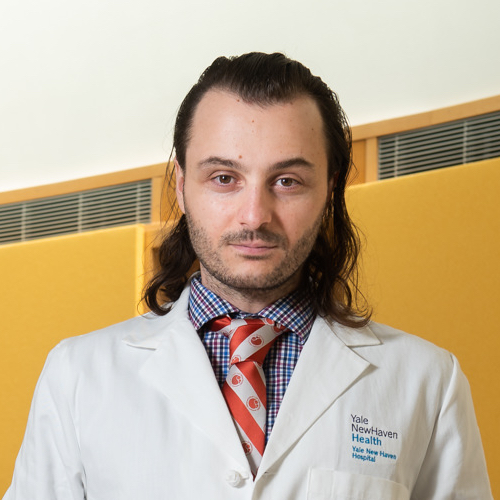
George Goshua is a 2023 NOMIS & Science Young Explorer Award finalist. He is assistant professor of medicine (hematology) at the Yale University School of Medicine (New Haven, US).
George Goshua received his MD from the University of Kentucky (US), completed his clinical residency and fellowship training in internal medicine and hematology–oncology at Yale University under the guidance of Thomas P. Duffy and Alfred I. Lee. He later completed an MS focused on risk and decision science at the Harvard T.H. Chan School of Public Health under the supervision of Ankur Pandya. He established his laboratory in the Department of Internal Medicine at the Yale School of Medicine in November 2022. His research applies health decision science methodology to identify equity-informed, cost-effective diagnostic and therapeutic treatment strategies for persons living with hematologic and oncologic diseases.
His award-winning essay, “Napkin math can change the world,” describes how mathematical models hold the key to equitable patient care.
‘s publications
Cost-effectiveness of iron deficiency screening in pregnancy across ferritin-based thresholds
Maternal iron deficiency (ID) affects nearly 85% of all pregnancies worldwide by the third trimester and is strongly linked with maternal morbidity, poor birth outcomes, and cognitive and behavioral developmental deficits in children. Despite its burden on maternofetal health, no guidelines exist for routine screening of ID in pregnant individuals in the United States. The World Health Organization uses a diagnostic (ie, nonscreening) ferritin threshold of 15 μg/L for ID in the first trimester of pregnancy, with no guidance for the second and third trimesters. Routine screening for ID in pregnancy could identify a large proportion of mothers who remain undiagnosed and untreated under the current clinical status quo. Accordingly, we conducted, to our knowledge, the first cost-effectiveness analysis of ferritin-based ID screening in pregnant women in the United States, comparing thresholds of (1) 30 μg/L vs (2) 15 μg/L vs (3) no screening from a modified US societal perspective accounting for wages lost to infusion time, infusion administration costs, and the cost of annual hematology follow-up. We found that screening at 30 μg/L was the preferred strategy across extensive base-case, threshold, and sensitivity analyses and across all examined willingness-to-pay thresholds, with an incremental cost-effectiveness ratio of $34 000/quality-adjusted life year (QALY; 95% credible interval, $32 000-$36 200/QALY) compared with no screening. No parameter variation changed this outcome, and screening at 30 μg/L was favored in 100% of 10 000 Monte Carlo iterations. Population-level regular second- and third-trimester screening for ID using physiologically informed ferritin ranges should be considered for all pregnant women in the United States.
Research Fields
Clinical Medicine, Health Sciences, Immunology
Haploidentical transplant, gene therapy, and standard care in sickle cell disease: a cost-effectiveness analysis
Nonmyeloablative-related haploidentical allogeneic stem cell transplantation (NMAC-HID allo-HSCT) has emerged as an additional treatment to achieve durable remission in sickle cell disease (SCD), a prevalent blood disorder characterized by painful vaso-occlusive crises and chronic anemia. The standard of care (SOC) for SCD includes hydroxyurea, pain management, and blood transfusion, but patients with SCD still lose several decades of life expectancy. Gene therapy (GT) for SCD is the other treatment for lifelong disease amelioration in SCD, with accessibility limited by cost and manufacturing capacity in the United States and globally. Two recent prospective studies that evaluated NMAC-HID allo-HSCT validated haploidentical allotransplantation as an efficacious and accessible treatment option in the era of GT. Given the ongoing price negotiation across jurisdictions for GT implementation and the absence of cost-effectiveness data comparing NMAC-HID allo-HSCT and GT, we conducted a cost-effectiveness analysis of NMAC-HID allo-HSCT vs GT vs SOC for adults and children living with SCD. The primary outcomes were the incremental cost-effectiveness ratio and the net monetary benefits across these 3 strategies. The secondary outcome was the maximum cost-effective threshold price for GT compared with NMAC-HID allo-HSCT. Treatment with SOC, NMAC-HID allo-HSCT, and GT accrued 14.3, 20.1, and 22.1 quality-adjusted life-years at costs of $1.22 million, $1.15 million, and $2.75 million, respectively. NMAC-HID allo-HSCT was the cost-effective strategy compared with GT in 100% of 10 000 Monte Carlo iterations across the base case and all scenario analyses. The maximum cost-effective thresholds for GT vs SOC were $1.4 million in the United States and $4200 to $22 000 across India, Nigeria, and Tanzania, depending on willingness-to-pay thresholds.
Research Fields
Clinical Medicine, Health Sciences, Immunology
‘s news
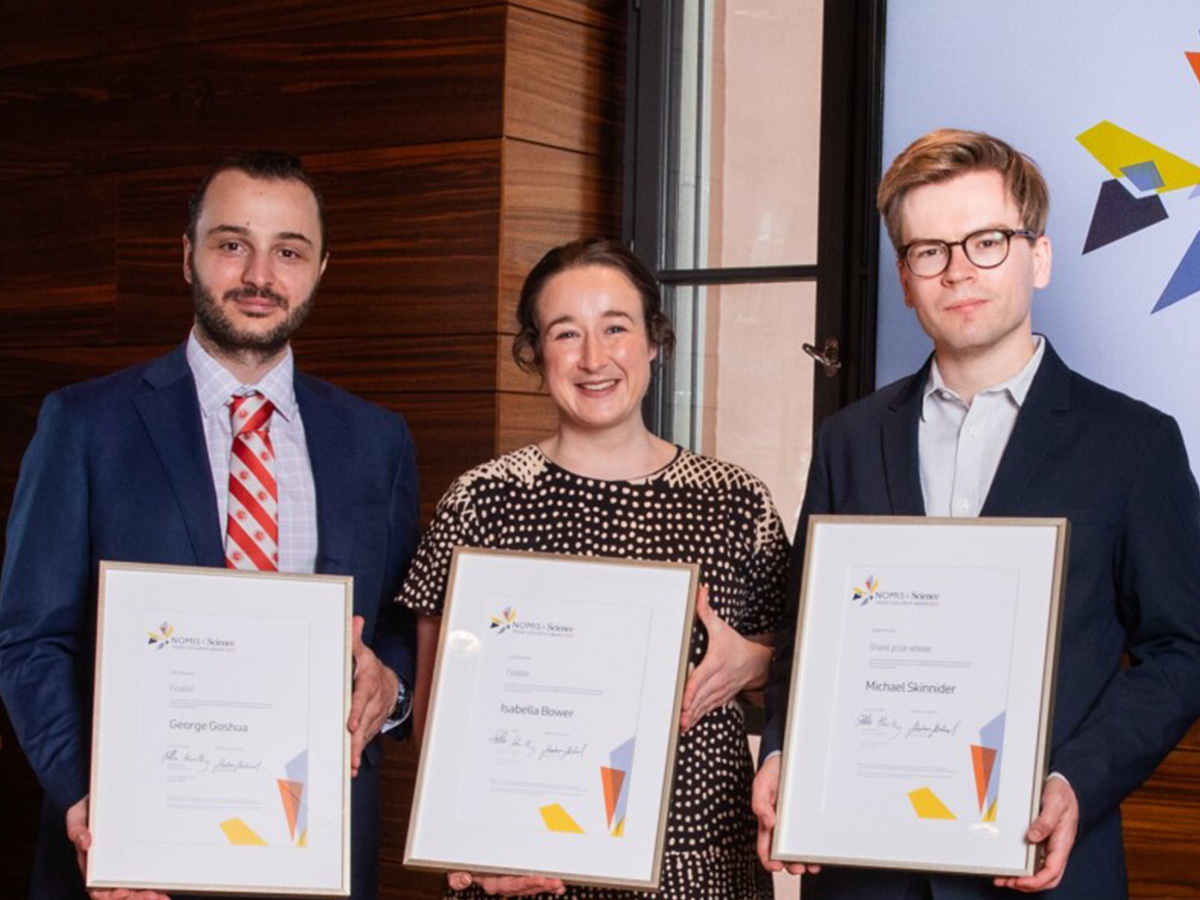
Recognizing young research talent, the 2023 NOMIS & Science Young Explorer Award was presented to grand prize winner Michael Skinnider and finalists Isabella Bower and George Goshua at a ceremony on Wednesday, June 5, 2024, at the University of Zurich, Switzerland. Science Deputy Editor Stella Hurtley; Bill Moran, publisher of the Science family of journals; […]

November 9, 2023
2023 NOMIS & Science Young Explorer Award winners announced
Science/AAAS and the NOMIS Foundation have announced the winners of the 2023 NOMIS & Science Young Explorer Award, which recognizes bold early-career researchers who ask fundamental questions at the intersection of the social and life sciences. AI-Based Approach Used to Fight Illicit Designer Drugs Epidemic For developing an artificial intelligence-based approach to identify new designer […]