
Chemosignaling and Related Biology of Human Social Interactions

The Question
The belief that humans have a poor sense of smell compared to other animals is false. Olfaction in humans serves important purposes. In addition to the assessment of the safety of the environment (e.g., the presence of toxins, fire or predators), olfaction is also used for social purposes, to identify romantic partners, offspring and friends, often working in a subliminal way.
Relatedly, humans also have the capacity to naturally emit distinctive odors. Healthy humans produce more than 2,746 volatile organic compounds in different combinations and concentrations. Our complex and unique odor profiles (our “volatilome”) can thus serve as social chemosignals. These olfactory cues play an important and underexplored role in human social connection, including with respect to deep and fundamental attributes of our species such as friendship, trust and cooperation.
In prior work, Nicholas A. Christakis’ lab showed that friends have similar (genetic) senses of smell, at least in certain respects. This finding was in keeping with other evidence that olfaction plays a role in primate kin recognition and with evidence that people are able to distinguish friends from strangers based on blind tests of overall odor.
Findings such as these all suggest that recognition of friends and the formation of nonreproductive social ties are at least partially related to body odor. But how and to what extent this happens is relatively unexplored. Also unknown is the extent to which particular chemical cues govern diverse features of social interactions, including trust and altruism.
The Approach
The Chemosignaling and Related Biology of Human Social Interactions project will integrate methods developed in network science, environmental and forensic science, social science, and genetics into a human chemosignaling research program. It will use various state-of-the-art odor sampling technologies, genetic sequencing, gas chromatography–mass spectroscopy (GC–MS), olfactory “fingerprinting,” and gold-standard mapping of face-to-face human social networks. In this way, the research team will characterize and map the chemical profile of human scent and identify pathways connecting human odor and olfaction to human friendship and cooperation.
They will perform two kinds of studies: First, for over 2,000 people living in isolated villages in rural Honduras (a longstanding field site), they will profile human odor by sampling and characterizing the human skin volatilome (creating the largest population-level database of human odor yet assembled); sequence olfactory genes; and perform olfactory fingerprinting (i.e., a comprehensive assessment of a subject’s ability to detect and assess various odors). They will also map human social networks in detail and assess cooperation, trust, and altruism in co-villagers. Second, other experiments will pair people anonymously with each other; sample their whole-body volatilome; and measure how their cooperative behaviors vary with controlled exposure to the scent of others.
These efforts will address several primary research questions, including: Does human scent carry chemosignals that could potentially influence formation of friendship ties? Do groups of friends have similar odors? Do particular, identifiable volatile chemical compounds modulate prosociality in pairs of people who are interacting?
This work might conceivably lead to the discovery of combinations of volatile compounds that might be formulated so as to enhance friendliness and trust in groups that must work together, or might potentially be used to diagnose groups that are not effective (because of discordant olfactory signals). Diagnostic tests for physical or mental illnesses could also arise from this work. The findings are also likely to be relevant to the development of olfactory artificial intelligence (including via ongoing efforts in the Christakis lab). And this work might support the inference that one partial explanation for toxic online interactions (so widely ascendent nowadays) is the lack of olfactory cues.
This line of new, fundamental research seeks a deeper understanding of how human olfactory cues are linked to diverse social behaviors. The team expects to discover how olfaction shapes friendship, trust and cooperation, which in turn shape how functional, happy and salubrious a society can be.
The Chemosignaling project is being led by Nicholas A. Christakis at Yale University in New Haven, US.
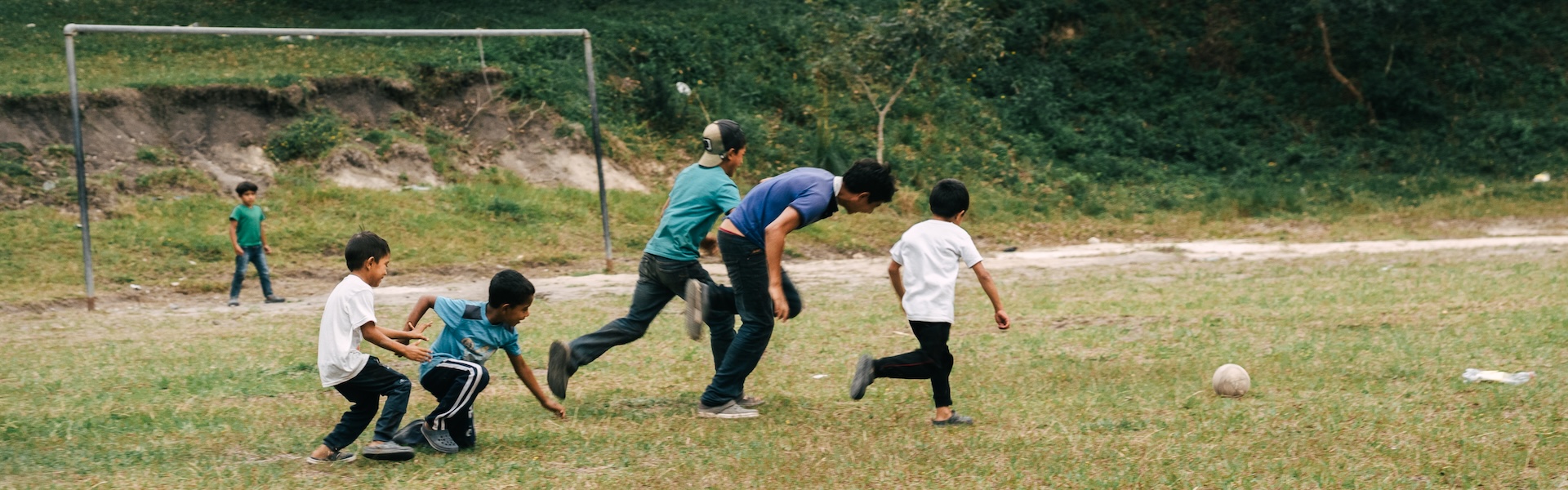
Feature image: Children playing soccer in Copán, Honduras, where the Christakis lab’s research revealed that our friends — and also their friends — shape our gut microbiome. Photo by Andrew Jordan.
NOMIS researchers

About Nicholas A. Christakis Nicholas A. Christakis is leading the Microbiome Biology and Social Networks in the Developing World project. He is the Sterling Professor of Social and Natural Science at Yale University (New Haven, US) with appointments in the Departments of Sociology, Medicine, Biomedical Engineering, Evolutionary Biology, and Data Science. Born in the US, Christakis obtained a […]
Sterling Professor of Social and Natural Science
Yale University
