
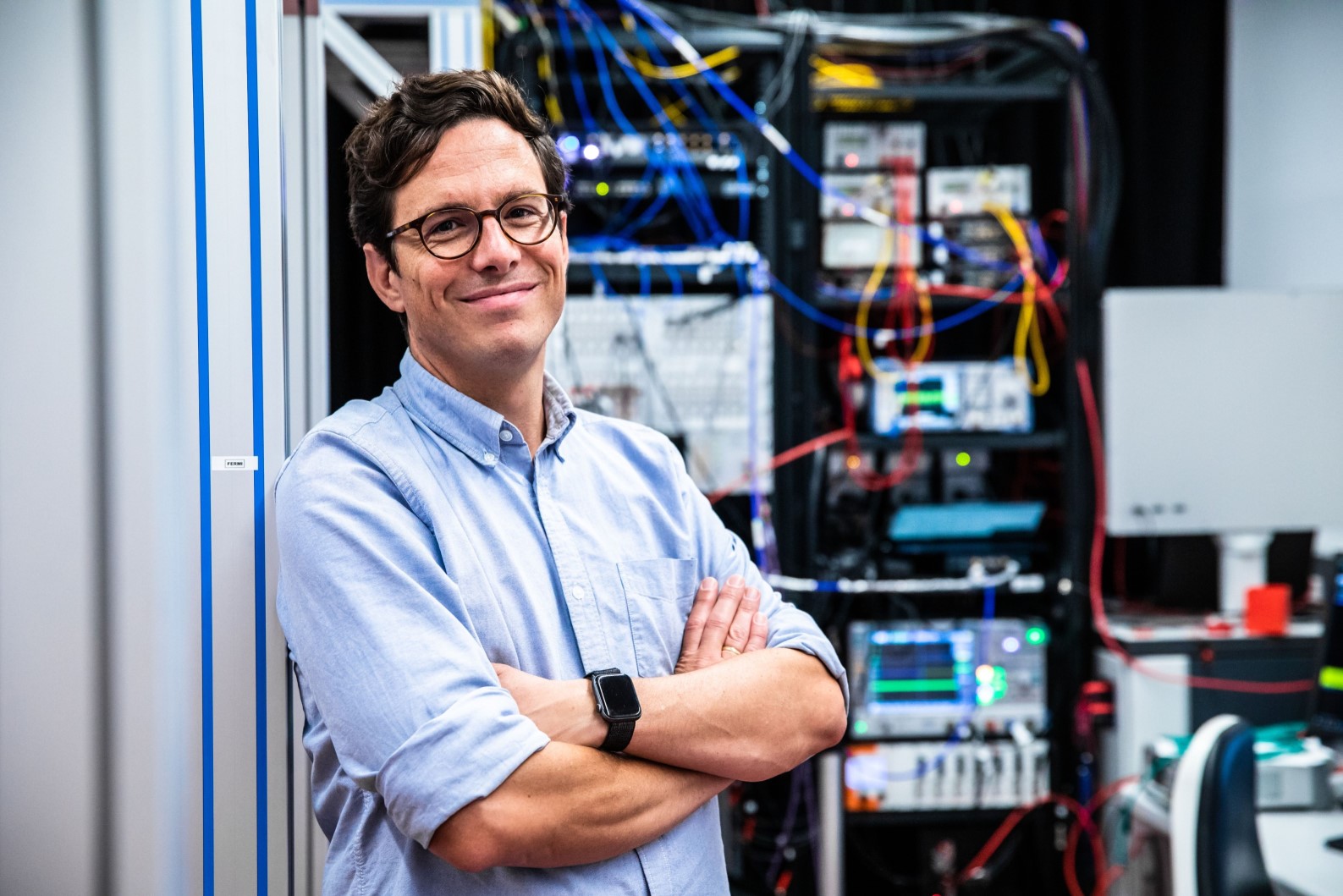
Johannes Fink
Professor
Organization
Institute of Science and Technology Austria (ISTA)

About Johannes Fink
Johannes Fink is professor at the Institute of Science and Technology Austria (ISTA). He co-led the Hybrid Semiconductor—Superconductor Quantum Devices project and is currently co-leading the Protected States of Quantum Matter project.
Born in Austria, Fink studied physics at the University of Vienna. At ETH Zurich (Switzerland) he conducted a PhD in the field of circuit quantum electrodynamics for which he was awarded the ETH Medal in 2010. After a postdoc at ETH he became IQIM postdoctoral scholar and a senior staff scientist in the Department of Applied Physics at the California Institute of Technology. In January 2016 he started the Quantum Integrated Devices laboratory at ISTA. Fink is the recipient of numerous other awards and prizes, including the CSF Award (2009), an IQIM fellowship (2012), an ERC starting grant (2017) and the Fritz Kohlrausch award (2018).
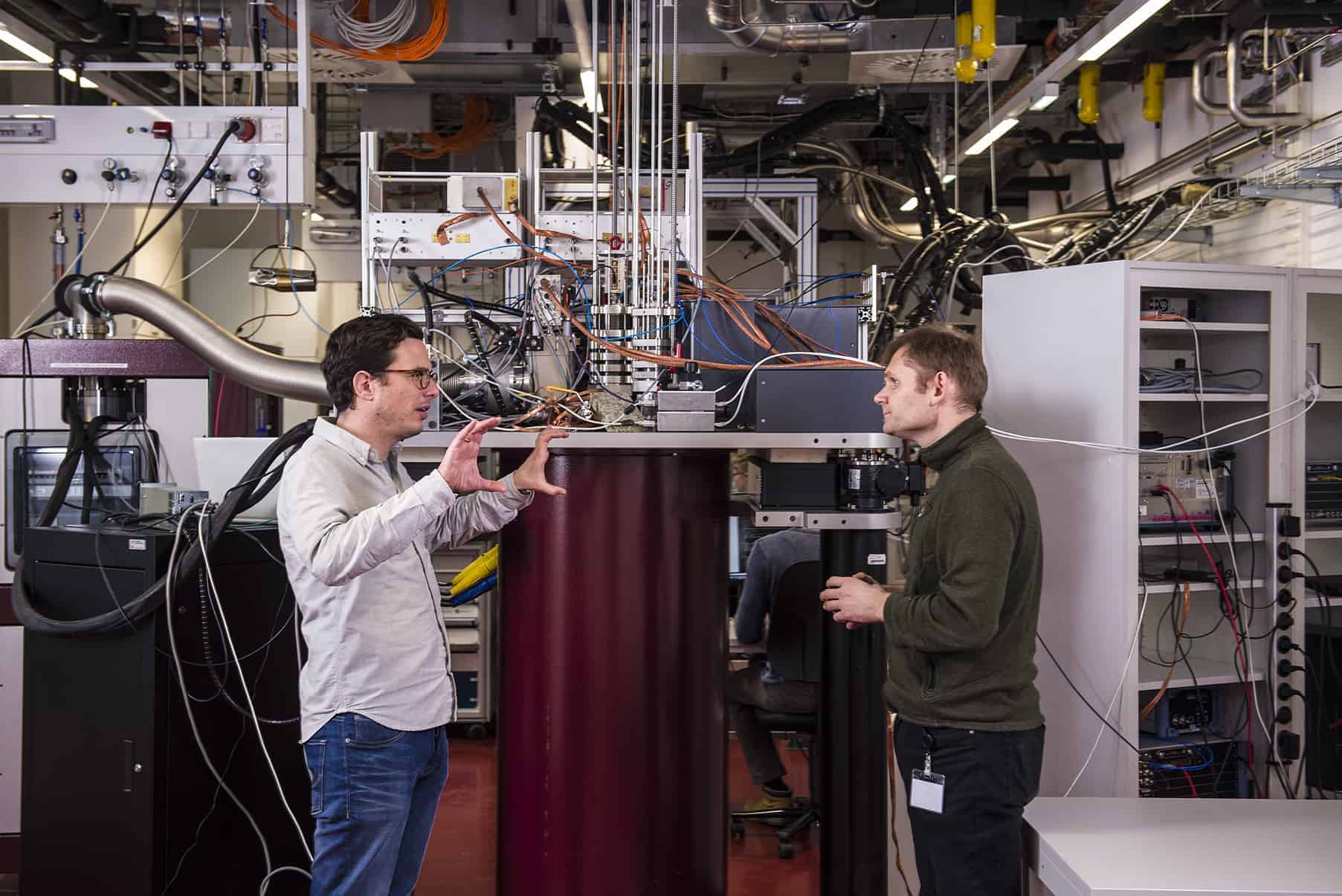
Fink’s research is positioned at the intersection of quantum optics and mesoscopic condensed matter physics. He studies quantum coherent effects in electrical, mechanical and optical chip-based devices with the goal of advancing and integrating quantum technology for simulation, communication, sensing and metrology. During his PhD at ETH Zurich he observed the geometric phase and studied fundamental interactions between light and matter in superconducting electrical circuits. As a postdoc at Caltech he developed a new electro-mechanics platform and demonstrated motional ground state cooling of a dielectric nanobeam. At ISTA he used mechanical motion to realize an on-chip microwave circulator, for which he was awarded the physics prize of the Austrian Physical Society, and to deterministically generate and distribute entangled microwave radiation.
‘s projects
Protected States of Quantum Matter
Major corporations have recently made dramatic investments toward building a quantum computer. The current level of technological development has been referred to as the era of noisy intermediate-scale quantum computing (NISQ), reflecting the fact that currently available quantum processors are dominated by noise. In fact, because current systems are unprotected, the effect of noise increases […]
NOMIS researchers
Project period
2022 – 2026
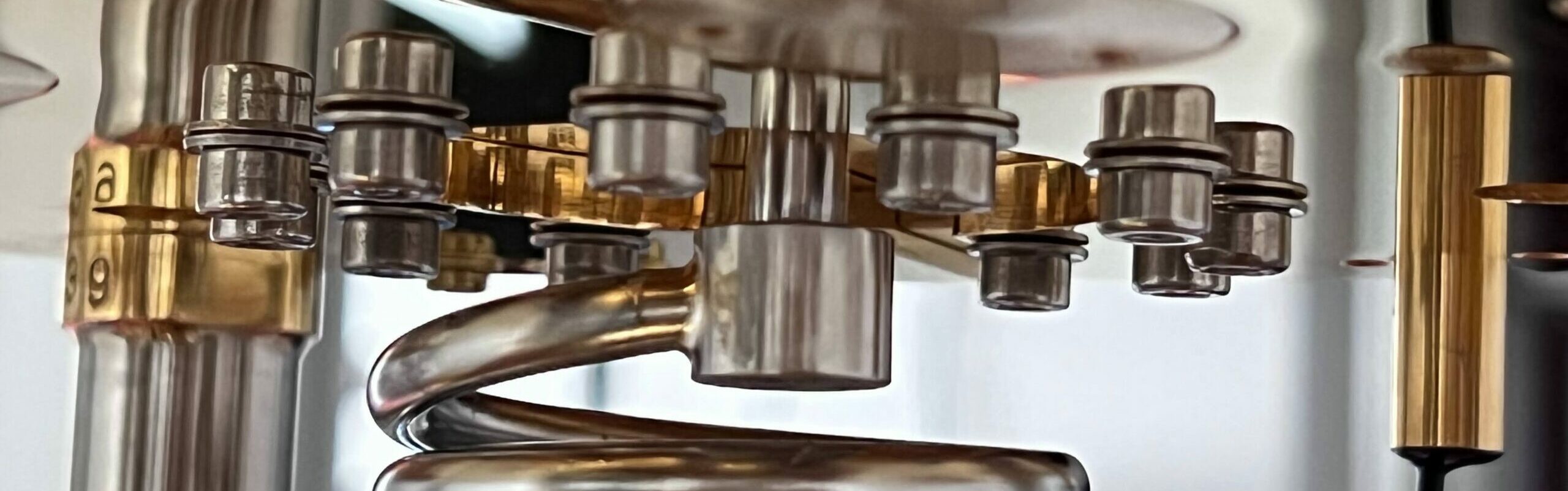
Hybrid Semiconductor–Superconductor Quantum Devices
Embedded in the research infrastructure of the Institute of Science and Technology Austria (ISTA), the Hybrid Semiconductor–Superconductor Quantum Devices project aimed to answer some of the fundamental questions of quantum physics. Specifically, the research team investigated how to use the quantum state of microscopic nanofabricated physical systems as building blocks for the elusive vision of […]
NOMIS researchers
Project period
2017 – 2021
‘s publications
Observation of Collapse and Revival in a Superconducting Atomic Frequency Comb
Recent advancements in superconducting circuits have enabled the experimental study of collective behavior of precisely controlled intermediate-scale ensembles of qubits. In this work, we demonstrate an atomic frequency comb formed by individual artificial atoms strongly coupled to a single resonator mode. We observe periodic microwave pulses that originate from a single coherent excitation dynamically interacting with the multiqubit ensemble. We show that this revival dynamics emerges as a consequence of the constructive and periodic rephasing of the five superconducting qubits forming the vacuum Rabi split comb. In the future, similar devices could be used as a memory with in situ tunable storage time or as an on-chip periodic pulse generator with nonclassical photon statistics.
Research Fields
Natural Sciences, Quantum

A gate tunable transmon qubit in planar Ge
Gate-tunable transmons (gatemons) employing semiconductor Josephson junctions have recently emerged as building blocks for hybrid quantum circuits. In this study, we present a gatemon fabricated in planar Germanium. We induce superconductivity in a two-dimensional hole gas by evaporating aluminum atop a thin spacer, which separates the superconductor from the Ge quantum well. The Josephson junction is then integrated into an Xmon circuit and capacitively coupled to a transmission line resonator. We showcase the qubit tunability in a broad frequency range with resonator and two-tone spectroscopy. Time-domain characterizations reveal energy relaxation and coherence times up to 75 ns. Our results, combined with the recent advances in the spin qubit field, pave the way towards novel hybrid and protected qubits in a group IV, CMOS-compatible material.
Research Fields
Josephson Junctions, Qubits

Compact vacuum-gap transmon qubits: Selective and sensitive probes for superconductor surface losses
State-of-the-art transmon qubits rely on large capacitors, which systematically improve their coherence due to reduced surface-loss participation. However, this approach increases both the footprint and the parasitic cross-coupling and is ultimately limited by radiation losses – a potential roadblock for scaling up quantum processors to millions of qubits. In this work we present transmon qubits with sizes as low as 36×39μm2 with ≳100-nm-wide vacuum-gap capacitors that are micromachined from commercial silicon-on-insulator wafers and shadow evaporated with aluminum. We achieve a vacuum participation ratio up to 99.6% in an in-plane design that is compatible with standard coplanar circuits. Qubit relaxation-time measurements for small gaps with high zero-point electric field variance of up to 22 V/m reveal a double exponential decay indicating comparably strong qubit interaction with long-lived two-level systems. The exceptionally high selectivity of up to 20 dB to the superconductor-vacuum interface allows us to precisely back out the sub-single-photon dielectric loss tangent of aluminum oxide previously exposed to ambient conditions. In terms of future scaling potential, we achieve a ratio of qubit quality factor to a footprint area equal to 20μm-2, which is comparable with the highest T1 devices relying on larger geometries, a value that could improve substantially for lower surface-loss superconductors. © 2023 American Physical Society.
Research Fields
Josephson Junctions, Microwave, Natural Sciences, Quantum, Qubits
‘s news


February 17, 2025
Light from artificial atoms
NOMIS researcher Johannes Fink and other scientists at TU Wien and the Institute of Science and Technology Austria (ISTA) are using superconducting circuits to create new types of quantum systems that are much easier to control and much more tunable than natural quantum systems like atoms. The researchers developed a system that can be used to […]

March 14, 2023
FWF awards funding for multi-institutional research collaborations to NOMIS researchers at ISTA
Recognizing research clusters in Austria that combine high-level research, research training, and the promotion of young scientists, the Austrian Science Fund (FWF) has awarded funding for multi-institutional research collaborations to NOMIS researchers Johannes Fink, Andrew Higginbotham and Georgios Katsaros. To strengthen the research of national universities and institutes, the Austrian Science Fund (FWF) is kick-starting an ambitious funding campaign. Funding for five clusters of […]

December 16, 2020
Johannes Fink and colleagues demonstrate how to transport microwave quantum information via optical fiber
NOMIS scientist Johannes Fink and colleagues William Hease and Georg Arnold present two transducers that could enable quantum communication between superconducting processors. Their work was published in Nature Communications and PRX Quantum. Johannes Fink Quantum computing could revolutionize the world with absolutely secure communication and more powerful calculations. Currently, exclusively scientists and tech-giants use quantum computers […]
