
Enabling Fundamental Research
Some of the most important advances in science begin before the path is clear.
They begin when a researcher explores a question that is too early for consensus, too complex for a single discipline or too unconventional for traditional funding pathways. These questions require more than resources. They require time, freedom, trust and the courage to remain with uncertainty long enough for something new to emerge.
We support this high-risk basic research.
We are inspired by fundamental questions that cut across disciplines and challenge established thinking. How are living systems organized? How does the brain give rise to thought and behavior? How do humans coexist with one another, with nature and with technology?
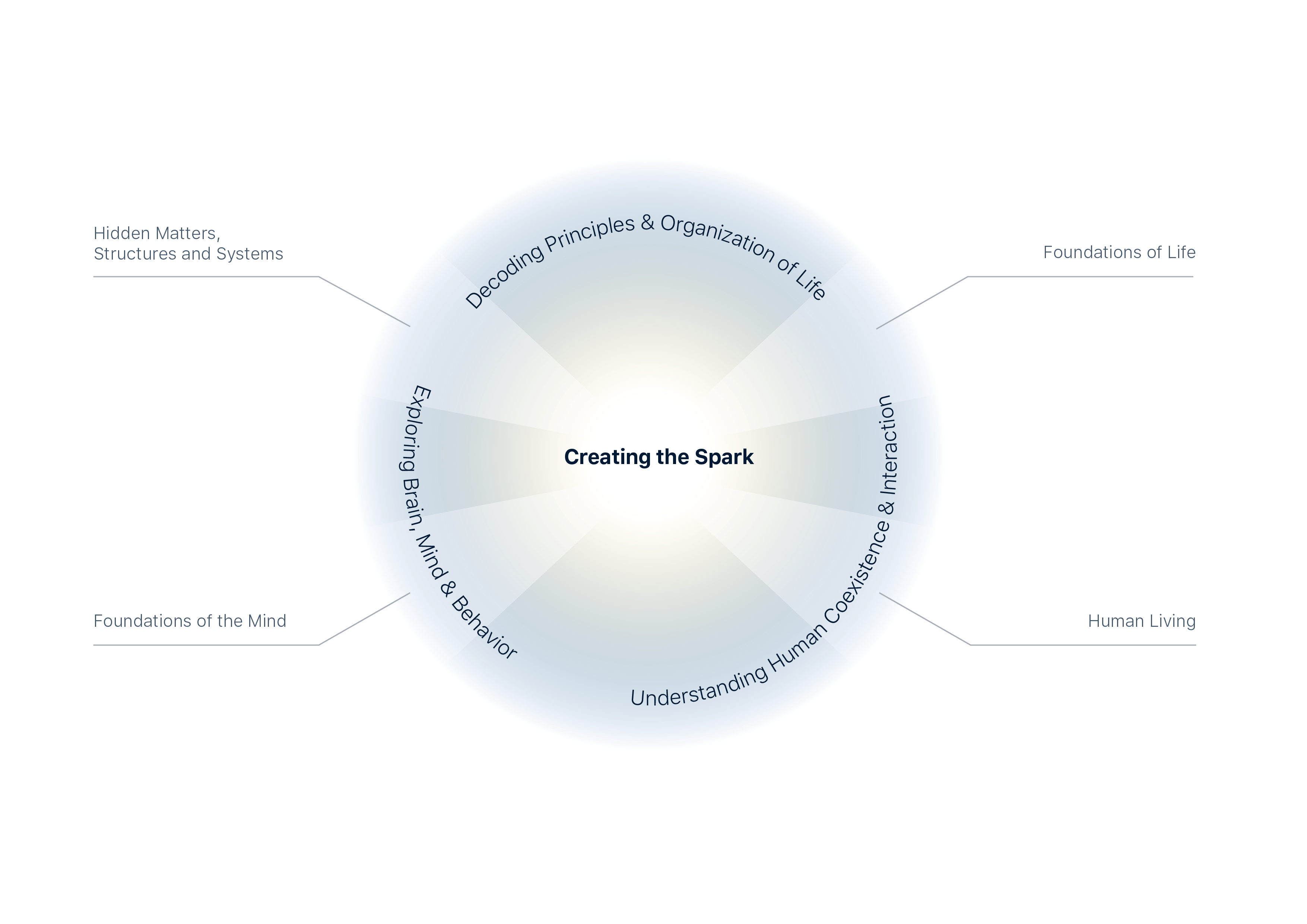
Our focus areas provide a compass for this exploration, guiding our way while leaving room for unexpected insights, emerging fields and new paths of discovery.
Our focus areas
Decoding Principles & Organization of Life
Living systems are organized across scales: from molecules and cells to organisms, ecosystems and the biosphere.
We support research that seeks to answer fundamental and holistic questions about life, its forms, its origins and the conditions that support and sustain it. We are interested in how diverse systems originate, function, interact and evolve within the biosphere.
This focus area invites research that reveals the hidden structures, relationships and organizing principles that make life possible.
Guiding question:
How are living systems organized?
Exploring Brain, Mind & Behavior
The brain is a biological system. The mind is what that biology becomes. Behavior is how both reveal themselves.
We support research that deepens our understanding of the human brain and the dynamic interplay between neurology, psychology and behavior. We are interested in work that bridges the biological mechanisms of the brain with the psychological processes of the mind.
This focus area encourages researchers to move across scales: from molecules, cells and neural circuits to cognition, emotion, decision-making and human behavior.
Guiding question:
How does the brain give rise to thought, emotion and behavior?
Understanding Human Coexistence & Interaction
Human life is shaped by relationships: with one another, with nature, with technology and with the systems we create.
We support research that explores the complex conditions of human coexistence and interaction. We are interested in how these relationships shape societies, environments, technologies and the future we share.
This focus area brings together perspectives from the social sciences, humanities, environmental research, behavioral science and emerging fields of inquiry.
Guiding question:
How do humans coexist with one another, nature and technology?
Why we fund research with uncertain outcomes
Much of today’s research funding emphasizes predictability and clearly defined deliverables, a model well suited to incremental progress in established fields.
We take a different approach. We fund the complex questions whose answers and impacts cannot be predicted. These explorations often require new tools, interdisciplinary collaboration and long time horizons before their significance becomes clear.
Reading genomes from ancient DNA took decades of method development. Studying the earliest stages of human embryos depended on experimental systems that did not yet exist. Understanding how institutions shape moral behavior demanded years of fieldwork rather than controlled lab experiments.
In each case, insight followed open inquiry, not a rigid plan. By funding bold questions rather than guaranteed outcomes, we embrace uncertainty. We prioritize deep understanding over speed, knowing that this is what ultimately enables future breakthroughs.