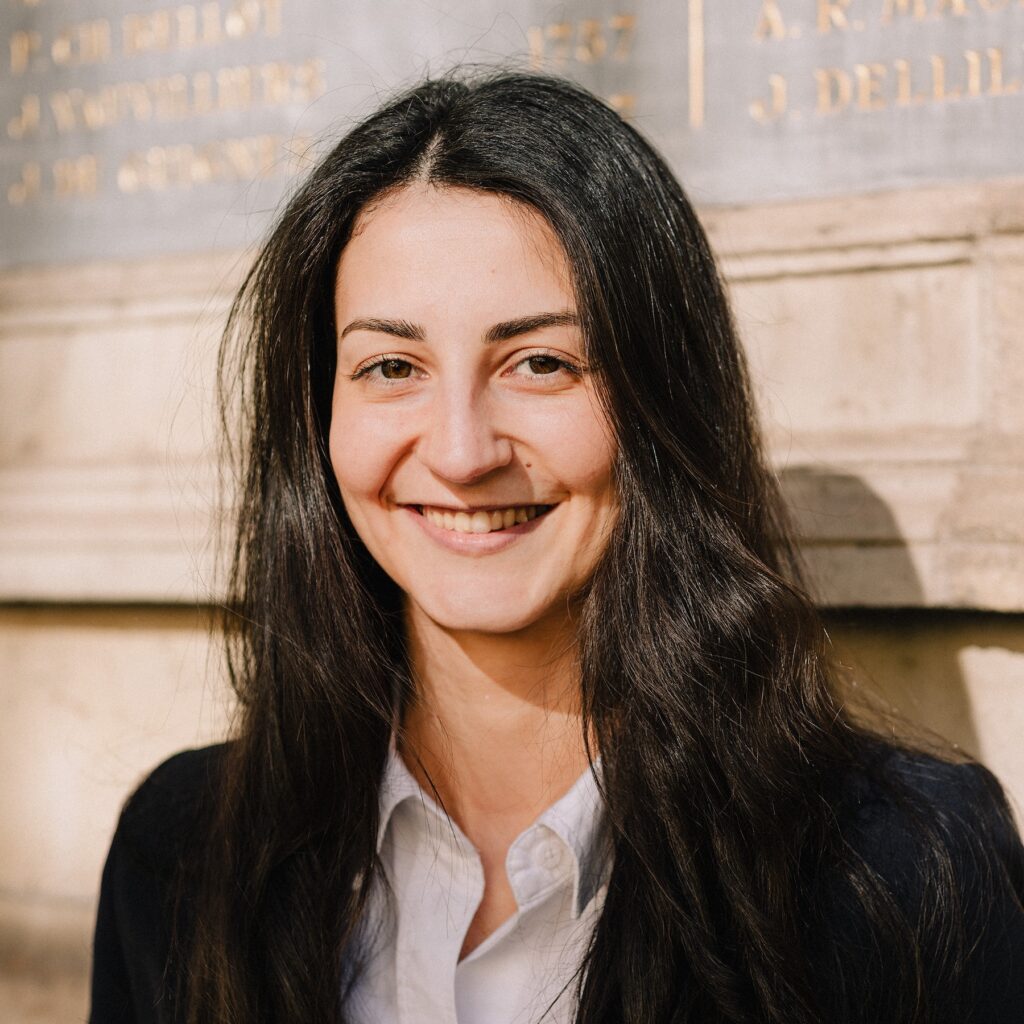

Emilie Skoog and Sarah Joiret have joined the ranks of NOMIS–ETH Fellows at the Centre for Origin and Prevalence of Life at ETH Zurich. This 2026 cohort of fellows will explore viruses as both key drivers and “archives” of microbial evolution and the origin of the volatile inventory that sustains life, and particularly water.
The NOMIS–ETH Fellowship Program fosters young interdisciplinary researchers in the field of the origin and prevalence of life who have demonstrated scientific excellence in the early stages of their careers.
Emilie Skoog
Emilie J. Skoog is a microbial and viral ecologist whose research bridges environmental microbiology, genomics, and geochemistry to understand how microorganisms and their viruses adapt to Earth’s most extreme environments and what these adaptations can reveal about life’s deep history. Her interest in astrobiology and life in environmental extremes began during her undergraduate studies at the University of Southern California. She later completed her PhD in Geobiology at MIT, where she applied metagenomics, microscopy, and biogeochemical analyses to study microbial mats from Shark Bay, Western Australia– modern analogs of some of the most ancient life on Earth – and virus-host dynamics in deep-sea hydrothermal vents.
During her postdoctoral research at the University of California, San Diego, Skoog expanded her work to explicitly study viruses as key agents – and potential archives – of microbial evolution and ecosystem function. She is now focused on virus-host interactions in hypersaline environments, which can harbor some of the highest viral abundances of any aquatic ecosystem. Across projects, she integrates experimental approaches with large-scale bioinformatic and multi-omics analyses (metagenomics, viromics, and metatranscriptomics) to connect viral traits to microbial metabolism, evolutionary dynamics, and environmental change.
“I will use viral protein surface charges as quantitative fingerprints of environmental chemistry, combining viral biophysics with evolutionary reconstruction to infer the geochemical conditions that shaped early microbial life.”
— Emilie J. Skoog
Starting in April 2026, Emilie Skoog will conduct her research in the Department of Environmental Systems Science, in the Environmental Microbiology Lab led by Prof. Marie Schölmerich. Her research explores how viruses associated with methanogens and acetogens – two of Earth’s most ancient microbial lineages – can reveal clues about the environmental conditions that supported early life. She investigates how the surface charge of viral structural proteins reflects environmental factors such as pH and salinity and may preserve signatures of the geochemical settings in which their microbial hosts would have evolved. By combining large-scale viral genomics, evolutionary reconstruction, and laboratory experiments that tests the rates of viral evolution, she aims to understand how viral surface chemistry and virus-host interactions evolve in response to environmental change. Through this work, Skoog seeks to establish viruses as both drivers and recorders of microbial evolution, offering a new perspective on the environmental conditions that may have shaped life on early Earth and on planets beyond our own.
Sarah Joiret
Sarah Joiret is a planetary scientist from Liège, Belgium. She is particularly interested in the dynamical evolution of planetary systems and its role in the transport and delivery of volatiles.
Prior to her PhD, she spent a year at the European Space Agency, where she developed her interest in solar system dynamics. She then completed her PhD at the University of Bordeaux, in collaboration with the Institut de Physique du Globe de Paris and the University of Bristol. Her project was highly interdisciplinary, combining dynamical modeling and experimental geochemistry, to constrain the role of comets in delivering volatiles to the early Earth. Joiret’s current postdoctoral research at the College de France focuses on extending this approach to Mars, providing new constraints to its early evolution.
“On Earth, comets likely contributed only minor amounts of water, carbon, and nitrogen-bearing species. However, different planetary system architectures may lead to significantly different cometary contributions.”
— Sarah Joiret
Starting in September 2026, Joiret will conduct her research in the Department of Physics under the mentorsip of Prof. Caroline Dorn. A central question in understanding planetary habitability is whether the volatile inventory that sustains life, and particularly water, originates primarily from accretion during planetary formation or from later delivery by small volatile-rich bodies. Within her NOMIS–ETH Fellowship, Joiret will investigate the latter hypothesis. In particular, she will explore how the architecture and dynamical evolution of planetary systems influence the probability of cometary impacts, and how these processes may affect the C/O ratio and volatile content of planetary atmospheres under different end-member scenarios. On Earth, comets likely contributed only minor amounts of water, carbon, and nitrogen-bearing species. However, different planetary system architectures may lead to significantly different cometary contributions. The ultimate goal of this project is to quantify the role of cometary delivery in shaping atmospheric composition across planetary systems.
Read the ETH Zurich release: 2026 Cohort of the NOMIS-ETH Fellows