
Susmita Malwade
NOMIS Fellow 2026-30
Organization
SyNergy

About Susmita Malwade
Susmita Malwade is a NOMIS–SyNergy Fellow at the Ludwig-Maximilians Universität in Munich (LMU Munich) within the Munich Cluster for Systems Neurology (SyNergy) in Germany. She is a postdoc in Martin Dichgans’ research group at the LMU Medical Center.
Born in India, Malwade obtained her MS in molecular medicine from Uppsala University in Sweden in 2019, completing her master’s thesis at the University of Copenhagen in Denmark on an Erasmus scholarship. She received her PhD in applied neurobiology from Karolinska Institutet in Stockholm, Sweden, in 2024.

Research focus
Malwade is interested in how cells adopt and shift between distinct states, and in the cellular signals that influence these transitions in health and disease. She first explored this in the developing human brain during her doctoral studies, asking how genetic and environmental risk factors for schizophrenia might alter the states of brain cells and with what consequences. This involved building patient-derived brain organoids populated with microglia, the brain’s resident immune cells, and combining them with multi-omic sequencing, focusing on how microglia interact with neurons and prune their synapses. She then contributed to the development of a computational tool for comparative single-cell analysis before turning her attention to the cerebral vasculature.
As a NOMIS–SyNergy Fellow, Malwade is exploring the fundamental mechanisms by which the cells of a blood vessel wall coordinate with one another through their immediate surroundings. Specifically, she is interested in the crosstalk between endothelial and vascular smooth muscle cells via the extracellular matrix, and how that exchange changes when HTRA1, a secreted protease acting within this compartment, is lost. Her work integrates multiple scales, from individual cell states to the organization of whole vascular networks, combining single-cell and spatial transcriptomic profiling of the cerebral vasculature in mice (Martin Dichgans group) with human iPSC-derived vascular models (Dominik Paquet group), in which HTRA1 can be deleted in defined cell types. She aims to establish whether the loss of this protease in one cell type is sufficient to disrupt the vessel wall, or whether it acts non-cell-autonomously between the two, and in which cell type the disturbance originates. By following how cells of different lineages jointly build and maintain the matrix between them, this work may also inform how vascular integrity is lost in small vessel disease, stroke and dementia.
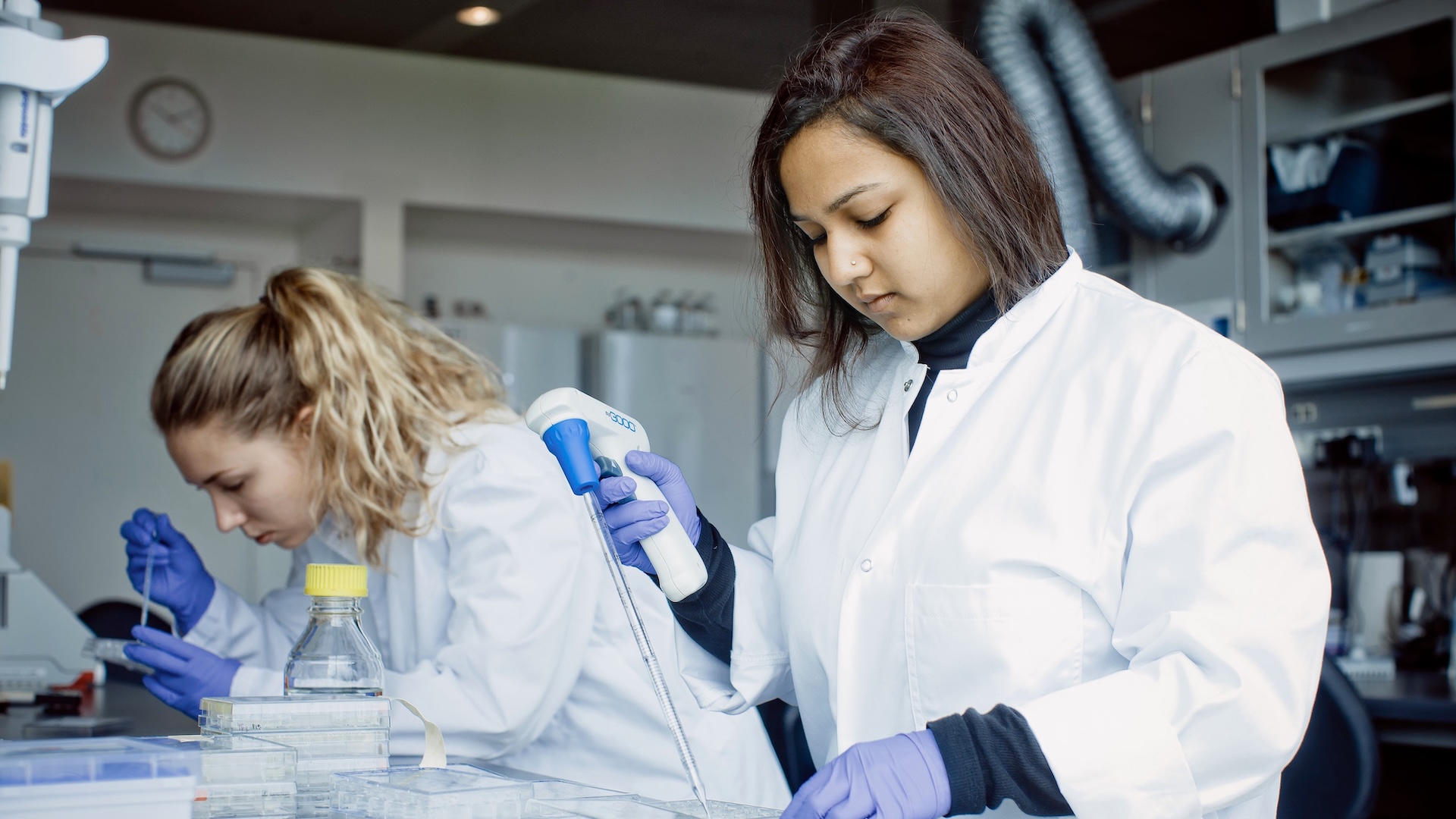
Top right: Susmita Malwade (Photo by Biotech Research and Innovation Centre, Copenhagen)
