

Ruggero Valli
NOMIS Fellow
Organization
Institute of Science and Technology Austria (ISTA)

About Ruggero Valli
Ruggero Valli is a NOMIS–ISTA Fellow at the Institute of Science and Technology Austria (ISTA), working with the research groups of Ylva Götberg (Massive Binary Stars) and Jorryt Matthee (Astrophysics of Galaxies).
Valli studied physics and astrophysics at the Sapienza University of Rome, Italy, where he obtained an MS in 2022. He then completed his PhD at the Max Planck Institute for Astrophysics in 2026.
Research focus
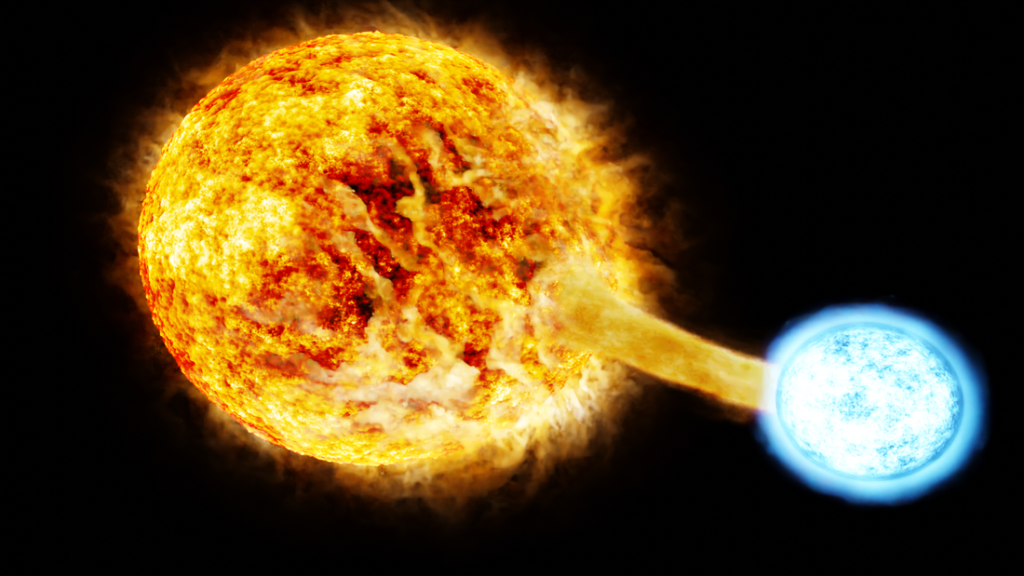
Valli’s research interests include the evolution of massive stars, their deaths in powerful supernova explosions and the black holes and neutron star remnants that they leave behind. Most massive stars come in pairs: They live in close binary systems where they can exchange mass, angular momentum and even merge into a single object. During his PhD studies, Valli focused on understanding these stellar interactions, which shape the evolution of the stars and determine their ultimate fate. He studied the effect of circumbinary disks on binary orbits and discovered a multimodal structure in the distribution of supernova kicks received by neutron stars at birth.
As a NOMIS–ISTA Fellow, Valli is investigating the very first stars of the universe, called Population III (or Pop III) stars. They formed from the pristine gas created in the big bang and played a critical role in shaping the early cosmos: driving the formation of the first galaxies, seeding supermassive black holes, and producing the first chemical elements heavier than hydrogen and helium. Despite their importance, no Pop III star has ever been directly observed. What do they look like and how can we identify them in our telescopes? Valli is tackling these open questions by simulating the internal structure and external appearance of Pop III stars, and how these change in the presence of a binary companion. These models will be compared with observations of the James Webb space telescope, setting the stage for confident detections of these elusive first stars, unlocking fundamental insights into the physical conditions of the early universe.
