
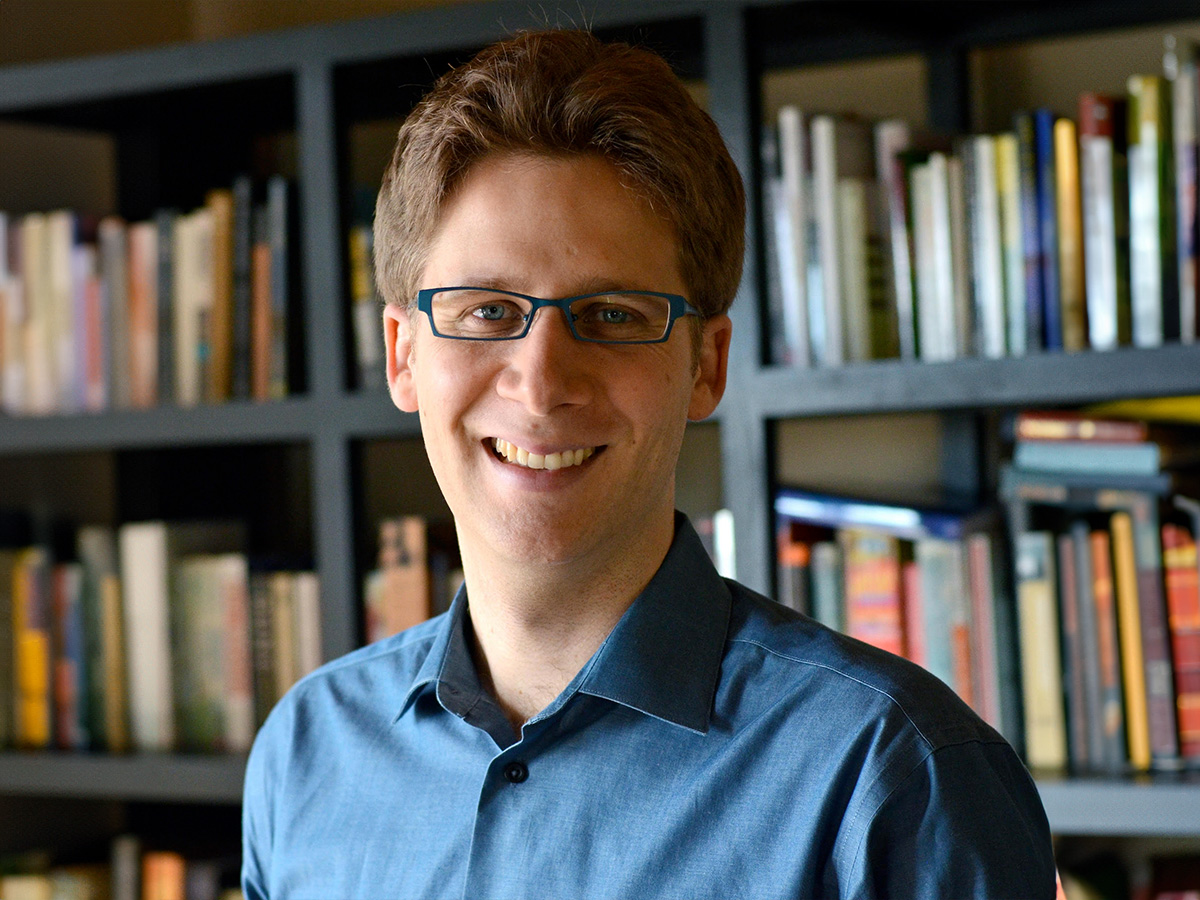
Tom Griffiths
Henry R. Luce Professor of Information Technology, Consciousness and Culture
Organization
Princeton University

About Tom Griffiths
Tom Griffiths is the Henry R. Luce Professor of Information Technology, Consciousness and Culture in the Departments of Psychology and Computer Science at Princeton University (Princeton, US). He is leading The Computer Science of Human Decisions project.
Born in the UK and having grown up in Australia, Griffiths earned a BA (Hons) from the University of Western Australia in 1998, receiving the J.A. Wood Prize for the best student in the Faculties of Arts, Law, and Economics. He came to United States for graduate school, receiving masters degrees in both psychology and statistics in 2002 and a PhD in psychology from Stanford University in 2005. He held faculty positions in the Department of Cognitive and Linguistic Sciences at Brown University (Providence, US) and the Department of Psychology and Cognitive Science Program at the University of California, Berkeley before moving to Princeton in 2018.
Griffiths works on interdisciplinary questions at the intersection of psychology and computer science. His research explores connections between human and machine learning, using ideas from statistics and artificial intelligence to understand how people solve the challenging computational problems they encounter in everyday life. He has received awards for his research from organizations including the American Psychological Association, the National Academy of Sciences, and the Guggenheim Foundation, and is co-author of the book Algorithms to Live By, introducing ideas from computer science and cognitive science to a general audience.
‘s projects
The Computer Science of Human Decisions
How do people trade off risk and reward? How do people decide how long they are willing to wait for a good thing? How do societies converge on good strategies for making decisions? For a long time, answering these questions has been the project of psychologists, economists and sociologists. However, the answers to these questions […]
NOMIS researcher
Project period
2021 – 2026
‘s publications

People use fast and flat simulation to reason about new games
Games have long been a microcosm for studying planning and reasoning in both natural and artificial intelligence, often focusing on expert-level or even super-human play1, 2, 3, 4, 5–6. But real life also pushes human intelligence along a different frontier, requiring people to flexibly navigate decision-making problems that they have never thought about before. Here we use novice gameplay to study how people reason about new problem settings. Through a series of large-scale behavioural studies with over 1,000 participants and 121 two-player strategic board games (almost all novel to our participants), we show that people are systematic and adaptively rational in how they play a game for the first time or evaluate a game (for example, how fair or how fun it is likely to be) before they have played it even once. We explain these capacities via a computational cognitive model that we call the ‘Intuitive Gamer’: a model based on mechanisms of fast and flat (depth-limited) goal-directed probabilistic simulation. Our work offers insights into how people rapidly evaluate, act and make suggestions when encountering novel problems, and could inform the design of more flexible and human-like artificial intelligence systems that can determine not just how to solve new tasks but also whether a task is worth thinking about at all.
Research Fields
Applied Sciences, Artificial Intelligence & Image Processing, Information & Communication Technologies

Resolving Feynman’s restaurant problem reveals optimal solutions and human strategies
In the 1970s, physicist Richard Feynman turned lunch with a friend into a math problem—how to optimize dish selection over multiple meals—but his handwritten notes remained a mystery for decades. Here we present the fully deciphered problem and solution, prove its optimality, generalize it to related problems, and compare the results to human behavior. The optimal policy specifies decreasing thresholds for switching from exploring new dishes to exploiting the best, with thresholds varying based on the distribution of the quality of dishes. We connect these results to the existing psychological literature on optimal stopping problems, which has explored close variants on Feynman’s problem, and use our generalization of the solution to explore how the underlying distribution of the quality of the options influences people’s choices. A preregistered experiment with 2,520 participants shows that people adopt thresholds that decrease linearly with the proportion of trials remaining, consistent with the observation of linear thresholds in other optimal stopping problems. However, we show that people tend to explore more than predicted by linear thresholds, and that different distributions of quality result in thresholds with the same slope but different intercepts. These results indicate that people adapt linear thresholds used in optimal stopping tasks in a way that is sensitive to the underlying distribution—a simple strategy that we show is nearly as effective as Feynman’s solution.
Research Fields
Experimental Psychology, Health Sciences, Psychology & Cognitive Sciences
A foundation model to predict and capture human cognition
Establishing a unified theory of cognition has been an important goal in psychology1,2. A first step towards such a theory is to create a computational model that can predict human behaviour in a wide range of settings. Here we introduce Centaur, a computational model that can predict and simulate human behaviour in any experiment expressible in natural language. We derived Centaur by fine-tuning a state-of-the-art language model on a large-scale dataset called Psych-101. Psych-101 has an unprecedented scale, covering trial-by-trial data from more than 60,000 participants performing in excess of 10,000,000 choices in 160 experiments. Centaur not only captures the behaviour of held-out participants better than existing cognitive models, but it also generalizes to previously unseen cover stories, structural task modifications and entirely new domains. Furthermore, the model’s internal representations become more aligned with human neural activity after fine-tuning. Taken together, our results demonstrate that it is possible to discover computational models that capture human behaviour across a wide range of domains. We believe that such models provide tremendous potential for guiding the development of cognitive theories, and we present a case study to demonstrate this.
Research Fields
Applied Sciences, Behavioral Science & Comparative Psychology, Health Sciences, Information & Communication Technologies, Psychology & Cognitive Sciences, Psychology & Cognitive Sciences
‘s news


NOMIS researcher Tom Griffiths and collaborators from institutions around the world have developed a computational model that can predict and simulate human behavior. Their research was published in Nature. Researchers at Helmholtz Munich have developed an artificial intelligence model that can simulate human behavior with remarkable accuracy. The language model, called Centaur, was trained on […]


April 28, 2025
How to break through climate apathy
“How can we convey the urgency of the [climate] crisis when its impacts appear so subtle?” NOMIS researcher Tom Griffiths and scientists at Princeton University, UCLA and Carnegie Mellon University explored this question, addressing the climate apathy among people who don’t experience regular climate-driven disasters. Their research suggests that communication is key: Presenting the same […]

October 8, 2024
Tom Griffiths named director of new interdisciplinary Princeton Laboratory for Artificial Intelligence
NOMIS researcher Tom Griffiths will spearhead Princeton University’s groundbreaking new AI Lab, uniting diverse disciplines to shape the future of artificial-intelligence research. By Yvonne Liu, Office of the Dean of the Faculty The Princeton Laboratory for Artificial Intelligence (AI Lab) will launch this fall to support AI research and incorporate interdisciplinary research from across the natural […]
