

Christian Perez-Martinez
NOMIS Fellow 2026-29
Organization
Smithsonian Tropical Research Institute (STRI)

About Christian Perez-Martinez
Christian Perez-Martinez is a NOMIS–STRI Fellow at the Smithsonian Tropical Research Institute (STRI) in Gamboa, Panama.
Perez-Martinez completed his BA in Integrative Biology at Harvard University and was awarded a post-baccalaureate fellowship to conduct research at Macquarie University. He then returned to Harvard to work as a research technician in the entomology collection of the Museum of Comparative Zoology. During his PhD at the University of Missouri-Columbia, Perez-Martinez studied the evolution of miniaturization in lizards and used tropical leaf litter geckos as a model to test hypotheses in behavioral and physiological ecology.
Research focus
Perez-Martinez is a behavioral ecologist interested in understanding how ecological pressures shape animal behavior and cognition. He is intrigued by the mechanisms underlying complex behaviors in very small animals, focusing on natural history and tropical systems. He is passionate about applying cutting-edge imaging and remote sensing methods to make discoveries about the natural history of poorly understood species. Perez-Martinez’s field research has taken him to diverse ecosystems across the world, including Costa Rica, Peru, Kenya, Australia and Puerto Rico. His focal study systems include lizards, butterflies, ant–plant mutualisms and spiders.
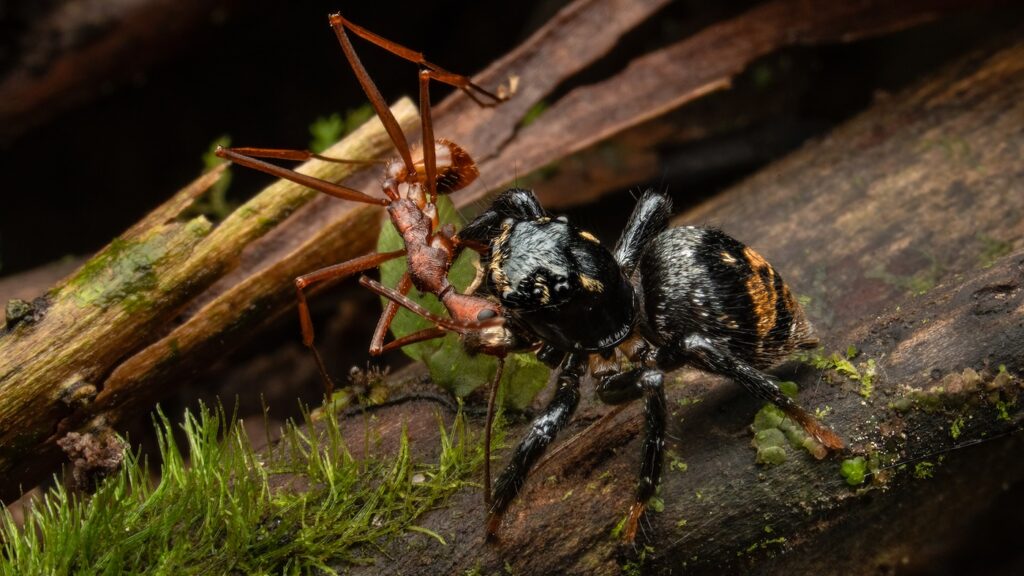
As a NOMIS-STRI Fellow, Perez-Martinez is examining the impact of habitat structure on foraging behavior and neuroanatomy. He is studying jumping spiders that specialize in hunting diverse ant species that occupy contrasting microhabitats in Panama’s tropical forests. Through lidar scanning and field experiments, Perez-Martinez is quantifying habitat structure at a submillimeter scale and assessing how spiders modulate their foraging strategies in response to variation in structural complexity and based on previous experience. He will also use immunofluorescence microscopy to characterize how changes in habitat structure during early and late life stages affect brain development. Habitat structure is a fundamental component of ecology, yet studies that contextualize species interactions with structural variation at fine spatial scales remain rare. Perez-Martinez’s research aims to address this gap and reveal how habitat features can actively shape cognitive processes.
Feature image by Cahill Shpall
