
Matthijs de Jong
NOMIS Fellow 2026-29
Organization
Institute of Science and Technology Austria (ISTA)

About Matthijs de Jong
Matthijs de Jong is a NOMIS-ISTA Fellow at the Institute of Science and Technology Austria (ISTA), working closely with the research groups of Johannes Fink (Quantum Integrated Devices) and Onur Hosten (Quantum Sensing with Atoms and Light).
De Jong obtained his BSc and MSc in applied physics from TU Delft, the Netherlands. He subsequently received his PhD from TU Delft in 2022, where he worked on the dynamical behavior of silicon nitride membranes. Afterwards, he held a postdoc position at Aalto University, Finland, where he explored the role of the Casimir force in superconducting drum resonators through their nonlinearity.
Research focus
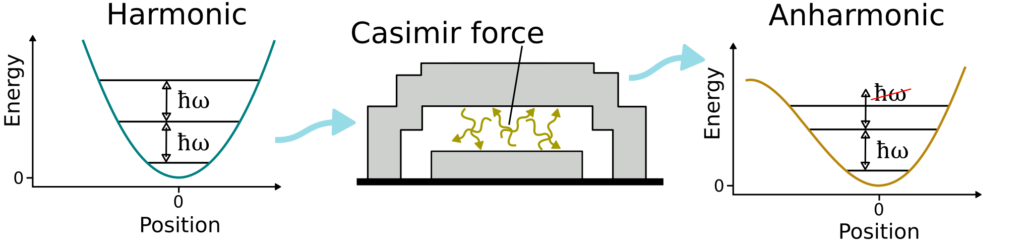
During his research journey, de Jong initially investigated the interaction of two silicon nitride membranes coupled by a single optical cavity. He found that thermal noise from the two membranes may be coherently canceled by a time-delayed interaction mediated by the cavity. His effort then moved to single-membrane systems without an optical cavity, to study their mechanical dissipation mechanisms and interactions between near-degenerate higher order modes. Furthermore, he showed that the standing wave optical field reflected from the substrate surface may cause nonlinearity and drive the silicon nitride membrane, which results in a mechanical frequency comb. After completion of his PhD, he focused on the nonlinear dynamics of superconducting drum resonators that have a very small vacuum gap. The Casimir force is large at small distances, and it induces a nonlinearity in the motion of these superconducting drums.
As a NOMIS Fellow, de Jong is pushing the mechanical nonlinearity to the quantum regime. Classical nonlinear mechanics involves large amplitudes of motion, but the Casimir nonlinearity should be strong enough to see the mechanical motion become nonlinear even in the few-phonon regime. A superconducting drum resonator in this regime would act as a mechanical qubit that can be integrated naturally with established superconducting quantum circuits (Fink group). Furthermore, the drum resonators are heavy, and their quantum states could provide an interesting experimental platform for experiments involving gravity or other forces (Hosten group). Casimir drums bridge an important gap between mechanical and quantum systems.
